

Motion Sensor Market Growth Accelerates with 5.05% CAGR During the Forecast Period to 2035
Motion Sensor Market
Motion Sensor Market Size, Share and Research Report By Technology (Infrared, Microwave, Ultrasonic, Radar / Tomographic), By Functionality Level
Motion Sensor Market is advancing due to growing adoption in smart homes, IoT devices, automotive systems, and security applications requiring real-time motion detection.”
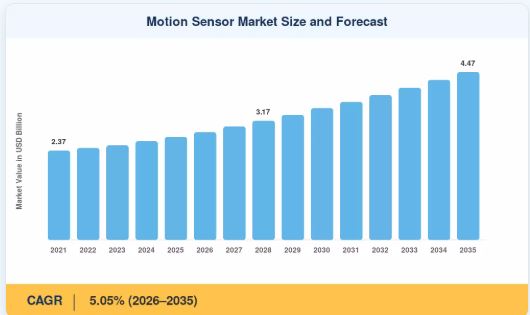
TOKYO, TOKYO, JAPAN, July 31, 2026 /EINPresswire.com/ -- The Global motion sensor market reached an estimated USD 9.74 billion in 2025 and is projected to grow from USD 10.68 billion in 2026 to USD 23.51 billion by 2035, registering a CAGR of 9.18% during the forecast period. Two major catalysts are accelerating this trajectory: the exponential expansion of smart home and building automation ecosystems across North America and Europe, and the surging integration of motion sensing technology in automotive ADAS (Advanced Driver Assistance Systems) and autonomous vehicle platforms. With over USD 2.4 trillion in global IoT infrastructure investment anticipated through 2035, manufacturers, system integrators, and end-user industries face mounting pressure to adopt intelligent sensing solutions or risk significant competitive disadvantage.— Market Research Future (MRFR)
Legacy passive infrared (PIR) sensor installations many constrained by limited detection angles, high false-alarm rates, and single-axis sensitivity are rapidly giving way to multi-technology fusion platforms that integrate microwave Doppler radar, ultrasonic sensing, LiDAR, and computer-vision-based motion analysis. A recent Deloitte IoT industry survey estimated that top-quartile smart building operators deploying AI-enhanced multi-sensor fusion systems achieved 31–36% reductions in false alarms and 22% improvements in energy management efficiency compared to peers still relying on standalone PIR installations. This technology shift is not incremental it represents a structural re-platforming of how the entire sensing industry addresses detection, occupancy management, and situational awareness.
Get Full PDF Sample Copy of Report: (Including Full TOC, List of Tables & Figures, Chart) @
https://www.marketresearchfuture.com/sample_request/2626
➤ How Significant Is the Motion Sensor Market’s Growth?
The motion sensor market has demonstrated consistent and robust expansion, rising from approximately USD 6.38 billion in 2021 to an estimated USD 9.74 billion in 2025, representing a healthy historical growth trajectory. The market is expected to more than double over the next decade, driven by the convergence of smart building automation, consumer electronics proliferation, industrial safety mandates, and the mainstreaming of autonomous mobility across automotive and robotics sectors.
Accelerating adoption of IoT-connected devices, rising security and surveillance infrastructure investments, and growing regulatory requirements for occupancy-based energy management in commercial real estate are creating acute demand for sophisticated motion detection solutions. Consumer electronics manufacturers, automotive OEMs, industrial automation providers, healthcare facilities, and smart city project developers are all investing heavily in next-generation motion sensing platforms to improve safety outcomes, reduce energy consumption, and enable new classes of intelligent applications.
➤ What Does the Future Hold for the Motion Sensor Market?
Artificial intelligence and multi-sensor data fusion stand at the forefront of the market’s next growth phase. AI-enhanced motion sensing platforms are transforming detection from a simple binary trigger mechanism into a contextually aware, predictive intelligence layer. Edge-based machine learning models now enable motion sensors to distinguish between human presence, animal movement, and environmental disturbances in real time dramatically reducing false positives while enabling nuanced behavioral analytics in security, retail, and healthcare environments.
The growing emphasis on contactless interaction and touchless human-machine interfaces is another defining force shaping the market’s future. From gesture-controlled consumer electronics and touchless elevator controls to radar-based vital-sign monitoring in healthcare facilities, motion sensors are expanding far beyond their traditional security and lighting control applications. Platforms combining millimeter-wave (mmWave) radar with AI analytics are enabling entirely new use cases including fall detection for elderly care, in-cabin occupant monitoring in vehicles, and crowd density analysis in public spaces.
Miniaturization and power efficiency improvements are also redefining deployment possibilities. Ultra-low-power motion sensor ICs now enable years-long battery operation in wireless IoT nodes, making ubiquitous motion sensing in remote, infrastructure-constrained, or high-density environments economically and operationally viable for the first time.
Direct Purchase this Research Report:
https://www.marketresearchfuture.com/checkout?currency=one_user-USD&report_id=2626
➤ Who Are the Key Players in the Motion Sensor Market?
The motion sensor landscape is characterized by a mix of established semiconductor manufacturers, diversified electronics conglomerates, and emerging IoT-native sensor specialists. Key participants shaping the competitive dynamics include:
Bosch Sensortec — delivering high-performance MEMS inertial and environmental sensors for consumer electronics, IoT, and automotive applications
Honeywell International — offering a broad portfolio of PIR, microwave, and ultrasonic motion sensors for security, HVAC, and industrial automation
Murata Manufacturing — providing advanced piezoelectric and MEMS-based motion sensing solutions across automotive, industrial, and consumer sectors
STMicroelectronics — supplying MEMS accelerometers, gyroscopes, and inertial measurement units (IMUs) for smartphones, wearables, and automotive systems
InvenSense (TDK) — specializing in high-performance MEMS gyroscopes and IMUs for consumer electronics, AR/VR, and precision navigation applications
NXP Semiconductors — delivering radar-based motion sensing solutions targeting automotive in-cabin monitoring, smart home, and industrial safety applications
Panasonic Corporation — offering dual-element and quad-element PIR sensors widely deployed in security, lighting control, and smart home automation
Infineon Technologies — providing mmWave radar sensors and MEMS microphones enabling presence detection, vital sign monitoring, and gesture recognition
Texas Instruments — supplying integrated radar sensor modules and analog front-ends for industrial, automotive, and building automation motion detection
Allegro MicroSystems -- delivering magnetic sensor ICs and current sensing solutions for automotive powertrain, ADAS, and industrial motion control applications
Competition in the market is intensifying as vendors race to embed AI inference at the edge, miniaturize sensor form factors for wearable and implantable applications, and develop integrated multi-modal sensing platforms that combine motion, presence, environmental, and biometric data in a single chip or module. Strategic acquisitions of MEMS startups, LiDAR specialists, and computer vision firms are fundamentally reshaping the competitive landscape.
➤ What Are the Emerging Trends in the Motion Sensor Market?
Several transformational trends are redefining how the motion sensor market evolves through 2035:
mmWave Radar Adoption: Millimeter-wave radar sensors are emerging as the premium detection technology for high-precision presence and motion sensing, enabling through-wall detection, vital sign monitoring, and 3D spatial mapping without camera-based privacy concerns.
AI & Edge Intelligence Integration: On-chip neural processing units (NPUs) embedded within sensor ICs are enabling real-time activity classification, anomaly detection, and predictive behavioral analytics without cloud connectivity dramatically reducing latency and data transmission costs.
Automotive ADAS & In-Cabin Sensing: Motion sensors are becoming integral to ADAS safety systems (pedestrian detection, blind-spot monitoring) and in-cabin occupant monitoring (driver drowsiness detection, child presence detection) as regulatory mandates drive adoption across global automotive markets.
Smart Building & Energy Management: Occupancy-based HVAC and lighting control driven by multi-zone motion sensing is becoming a cornerstone of green building certifications (LEED, BREEAM), creating sustained institutional demand for high-accuracy presence detection solutions.
Healthcare & Elderly Care Applications: Fall detection, gait analysis, sleep monitoring, and remote patient surveillance are driving specialized motion sensor adoption in hospitals, assisted living facilities, and home healthcare environments an addressable market projected to exceed USD 2.8 billion by 2035.
Sensor Fusion & Multi-Modal Platforms: Combining PIR, microwave, ultrasonic, LiDAR, and vision-based sensing in unified fusion architectures is enabling contextually aware detection systems that dramatically outperform single-technology alternatives in complex real-world environments.
Get access to the full description of the report @
https://www.marketresearchfuture.com/reports/motion-sensor-market-2626
➤ How Is the Motion Sensor Market Segmented?
The motion sensor market report provides a comprehensive segmentation framework:
1 By Technology: Passive Infrared (PIR), Microwave/Doppler Radar, Ultrasonic, Dual-Technology (PIR + Microwave), LiDAR, Image-Based
2 By End-Use Application: Security & Surveillance, Consumer Electronics, Automotive & Transportation, Industrial Automation, Healthcare, Smart Building & HVAC
3 By Connectivity: Wired, Wireless (Wi-Fi, Zigbee, Z-Wave, Bluetooth, LoRaWAN)
4 By Detection Range: Short Range (Up to 5m), Medium Range (5–25m), Long Range (Above 25m)
5 By Organization Size: SMEs, Large Enterprises
➤ What Are the Regional Insights from the Motion Sensor Market?
North America commands approximately 36% of global motion sensor market share, underpinned by the region’s advanced smart home ecosystem, large installed base of commercial security infrastructure, and robust demand from automotive OEMs and aerospace & defense programs. High consumer spending on home automation, combined with strict workplace safety regulations mandating industrial motion sensing, further reinforces the region’s leading position.
Europe holds the second-largest share at approximately 28%, with Germany, the United Kingdom, and France representing the primary markets. EU energy efficiency directives mandating occupancy-based building automation, combined with Germany’s leadership in automotive ADAS technology and robust industrial automation investment across the region, are primary market growth engines.
Asia-Pacific represents the fastest-growing major region, driven by mass-market consumer electronics production in China, South Korea, and Japan, rapidly expanding automotive manufacturing across the region, and government-led smart city infrastructure programs in India, China, and Singapore. The region’s large and growing middle class is also fueling consumer demand for smart home security and automation devices incorporating motion sensing technology.
Middle East & Africa is projected to register the highest CAGR at approximately 11.4% through 2035. Landmark smart city investments across Saudi Arabia (NEOM, Vision 2030 infrastructure programs) and the UAE (Dubai Smart City initiative), alongside growing commercial real estate development and security infrastructure investment across the region, are creating substantial demand for advanced motion sensing platforms.
South America rounds out the global picture, with Brazil and Mexico representing the most active markets for motion sensor deployment, particularly within commercial security, industrial safety, and smart building automation segments.
➤➤➤ Industry Analysis Reports by Market Research Future:
Finance Lease Market-
https://www.marketresearchfuture.com/reports/finance-lease-market-24473
Ship Searchlight Market-
https://www.marketresearchfuture.com/reports/ship-searchlight-market-24554
Life And Non Life Insurance Market-
https://www.marketresearchfuture.com/reports/life-and-non-life-insurance-market-24573
Assistive Robotic Market-
https://www.marketresearchfuture.com/reports/assistive-robotic-market-24582
Packaging Robots Market-
https://www.marketresearchfuture.com/reports/packaging-robots-market-24633
Medical Professional Liability Insurance Market-
https://www.marketresearchfuture.com/reports/medical-professional-liability-insurance-market-24643
Photosensitive Semiconductor Device Market-
https://www.marketresearchfuture.com/reports/photosensitive-semiconductor-device-market-24659
Gantry Robot Market-
https://www.marketresearchfuture.com/reports/gantry-robot-market-24689
Cards Payments Market-
https://www.marketresearchfuture.com/reports/cards-payments-market-24726
Banking Erp Software Market-
https://www.marketresearchfuture.com/reports/banking-erp-software-market-24836
Sagar Kadam
Market Research Future
+ + +1 628-258-0071
email us here
Legal Disclaimer:
EIN Presswire provides this news content "as is" without warranty of any kind. We do not accept any responsibility or liability for the accuracy, content, images, videos, licenses, completeness, legality, or reliability of the information contained in this article. If you have any complaints or copyright issues related to this article, kindly contact the author above.
